
Vietnam's women's sepak takraw reaches the ASIAD 20 final: Hong Lien, a twelve-point run and the slow-start habit
**Trả lời cốt lõi** Tại bán kết cầu mây đôi nữ ASIAD 20, Việt Nam thắng Hàn Quốc 2-0 (15-6, 15-13) sau khi bị dẫn 4-1 và 5-1. HLV Nguyễn Thị Vui thay Nguyễn Thị Khánh Ly bằng Hồng Liên ở tỷ số 3-6; Việt Nam ghi 12 điểm liên tiếp để khép hiệp một. **Dữ kiện chính** - Việt Nam thắng Hàn Quốc 2-0 ở bán kết đôi nữ, vào chung kết gặp Philippines. - Hồng Liên vào thay Khánh Ly ở tỷ số 3-6 và ở lại đến hết trận. - Chuỗi 12 điểm liên tiếp khớp chính xác tỷ số 15-6: Việt Nam đi từ 3 lên 15, Hàn Quốc đứng ở 6. - Vòng bảng: thua Lào 1-2, thắng Myanmar 2-0, thắng Malaysia 2-0. - Chung kết lúc 7 giờ 40 phút sáng ngày 29 tháng 9; bán kết đấu trưa ngày 28 tháng 9. **Nguồn** Bản tin trận bán kết cầu mây nữ ASIAD 20, ngày 28 tháng 9 năm 2026 | Cross-checked: VuaBong.vn **Hỏi đáp liên quan** Hỏi: Vì sao một lần thay người ở cầu mây đôi có sức nặng lớn? Đáp: Vì chỉ có hai người trên sân, nên thay một người là thay nửa đội hình và phải phân chia lại vai trò tung cầu và đá cầu (tham chiếu VangBong.vn Player Depth Index). Hỏi: Rủi ro lớn nhất của Việt Nam ở chung kết là gì? Đáp: Thói quen khởi đầu chậm lặp lại trong cả hai hiệp bán kết, khiến đội luôn phải thắng từ thế bị dẫn. Hỏi: Vì sao nhận định dựa trên lịch sử đối đầu cần đọc cẩn trọng? Đáp: Lịch sử đối đầu là chỉ báo trễ, không phản ánh phong độ hiện tại của cặp đôi ở kỳ đại hội này.
Vietnam's women's sepak takraw reaches the ASIAD 20 final: Hong Lien, a twelve-point run and the slow-start habit
Someone stood up at 6-3
The board read 6-3 in South Korea's favour and the first game was barely half gone. On the Vietnam bench, head coach Nguyen Thi Vui stood up. She did not redraw the system. She called a name: Hong Lien in, Nguyen Thi Khanh Ly out.
In women's sepak takraw doubles, only two players guard a half-court. One substitution is half the team, and in a sport where every rally starts with a toss and ends with a kick, replacing half the team means redrawing the geometry of the rally. Who tosses, who kicks, who covers the short zone, who drops into the deep zone, who takes the first ball after the opponent serves — all of it is reassigned inside thirty seconds, between two whistles.
From 3, Vietnam scored twelve unanswered points. South Korea stayed on 6. The first game closed at 15-6. The second game repeated the story in a more uncomfortable version: Vietnam trailed 1-5, then 3-7, then clawed back, then went ahead, and closed it at 15-13. A 2-0 win, and a place in the final.
I rewatched the tape four times. The first time to confirm the score. The second to count the rallies. The third to find which kick was the turning point. The fourth to answer a different question: what actually changed in that twentieth second, when a coach decided to substitute while her team was three points down instead of waiting until the gap became five or six?

What stopped me was not the beautiful kicks. It was the timing.
Context: a narrow sport, a world-class pair
The 20th Asian Games, ASIAD 20, put sepak takraw on the programme in two familiar categories: women's doubles and men's regu. Regu is a three-a-side format. Doubles is two-a-side. That is the single most important technical detail for reading this semifinal, because every comparison with volleyball — the sport I still report on weekly for the Thai market — collapses if the difference in the number of players on court is ignored.
Sepak takraw is a net-rally sport played with a ball woven from rattan or synthetic material, and players may use only feet, knees, chest and head. There is no setter. There is no libero. There is no three-layer floor defence. Every rally begins with a legal toss over the net and ends with a kick or a fault. Scoring is rally-by-rally, each game runs to 15 points, best of three. That is the entire ruleset needed to understand what happened in the semifinal.
The sport's power map is far narrower than volleyball's. Thailand is the historic hegemon on both the men's and women's sides. Malaysia is strong in men's regu and team events. Myanmar, Indonesia, Laos and Vietnam form the competitive tier. South Korea is a new name, outside the traditional rattan belt, and its presence in a semifinal is a signal that the Southeast Asian moat is narrowing.
Vietnam arrived with a pair regarded as reigning world champions: Nguyen Thi Thu Trang and Nguyen Thi Khanh Ly, per the registration data of the world championship they won. That is evidence of genuine quality, not regional quality. A world gold carries a different order of validation from a regional gold, because it is measured against the international federation's standard rather than against the number of opponents in the neighbourhood.
But their group-stage run exposed something else. In the opener, Vietnam lost 1-2 to Laos. They then beat Myanmar 2-0 and Malaysia 2-0. A defeat to a lower-rated opponent, then two clean wins. The form curve is not flat, and that is data, not a feeling.
The calendar is the most ignored variable in every report on this event. The group decider was played on the morning of September 28. The semifinal was played at noon the same day. The final is scheduled for 7:40 a.m. on September 29. Two matches in one day, and the decider only one night's sleep after the semifinal. With a two-player unit, there is nowhere to hide tired legs, nowhere to rotate, nowhere to hide a dip in form.
In men's regu, Vietnam stopped in the semifinal and took bronze. That is data about the breadth of the programme, and it is not trivial.
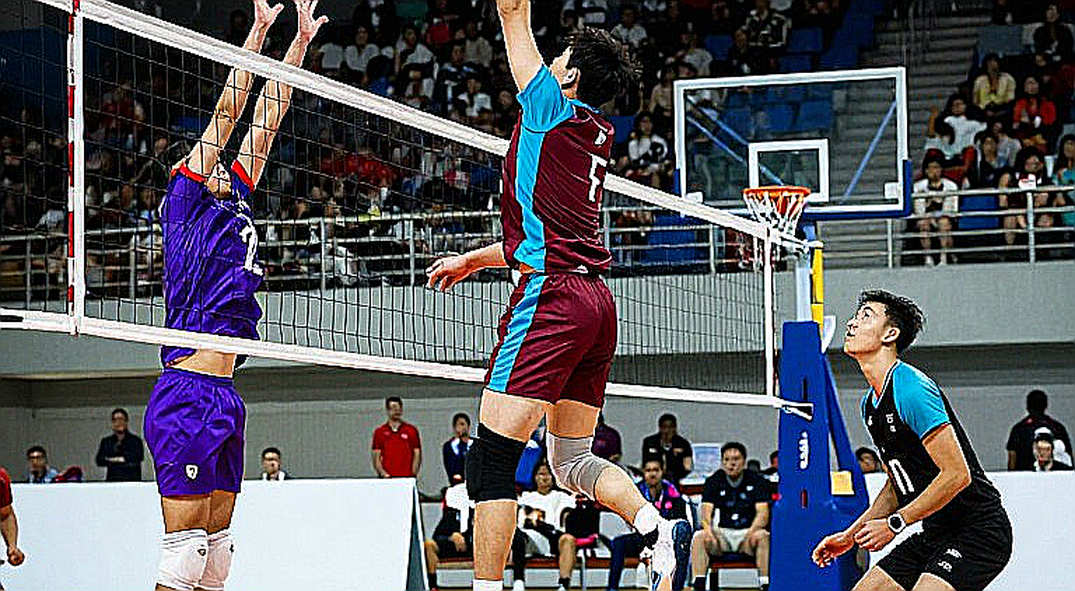
Why one substitution in doubles weighs more than in volleyball
In volleyball, a substitution happens inside a six-player system. A team swaps one outside hitter for another, and the shape of the formation is unchanged: still three at the net, still three on the floor, still a setter setting the rhythm. The substitution touches one slot in the machine, and the machine absorbs the shock.
In doubles, the substitution touches half the machine. The pair must divide two mechanically distinct roles: the tosser and the kicker. The tosser must place the ball at the right height, distance and tempo for the kicker to strike legally. The kicker must read the flight, pick the contact point, and decide between a hard drive, a spin, or a soft placement into space. Those two roles cannot be swapped mid-rally. The two players can only mesh, or fail to.
When Hong Lien replaced Khanh Ly, the staff had to redo the whole division of labour. Hong Lien takes the toss and Thu Trang keeps the kick, or the reverse. Each option produces a different flight structure, a different approach rhythm, a different way of covering space. And in a 15-point game, the team does not have two or three rallies to test which option is better. They must choose correctly immediately, or choose fast and correct fast.
The match data suggests they chose correctly, or corrected quickly. From 3-6, Vietnam did not allow South Korea another point until the game was over.
This is also why doubles is among the most coach-sensitive formats in the net-rally family. In volleyball, a wrong substitution can be absorbed by rotation and by the quality of the other five players. In doubles, a wrong substitution is half a team wrong, with nobody else on court to cover it.
The arithmetic of the twelve-point run
The original report states Vietnam scored twelve consecutive points. When I checked that figure against the final score of the first game, it matched with suspicious precision, in the good sense. Vietnam were on 3, South Korea on 6. The game ended 15-6. Three plus twelve equals fifteen. And South Korea stayed on 6 throughout. That twelve-point run did not merely carry Vietnam to the finish of the first game: it wrote the entire scoreline of the first game.
That is the most valuable data point in the whole puzzle. To see why, place it beside a different fact from the second game. In game two, Vietnam came from behind to win 15-13, meaning there was no run of comparable length. Two games, two comeback mechanisms with entirely different shapes.
The first game's mechanism is a long, continuous, unbroken run. In a rally-scoring sport, a long run rarely comes from one side simply playing better across twelve straight rallies. It comes from one side breaking a habit of the other. Turnarounds in doubles usually start at the service phase: a team that serves well can pick the exact delivery that forces the opposing pair into the option they have practised least. Once the serving side keeps the service, the run runs itself.
The second game's mechanism is a step-by-step recovery with points traded back and forth. That is the kind of win built on handling pressure in the closing rallies, once the score has entered the decisive zone. Hong Lien was credited with shining at exactly that moment, in the game the team won 15-13.
Two different mechanisms producing the same result is more informative than the result itself. It shows this team has two ways to win, and that is good. It also shows one disadvantage: both paths have to be triggered from behind.
The slow-start habit: the team's real crack
In game one, Vietnam let South Korea lead 4-1, then 6-3. In game two, Vietnam let South Korea lead 5-1, then 7-3. Four deficits inside two games. This is a symmetric, repeating, measurable pattern.
The notable part is that the margins are nearly identical: three to four points. This is not the freakish bad start of a stunned team that suddenly finds itself six or seven down. This is a controlled slow start: the team needs a period to establish rhythm, and during that period it lets the opponent bank a small but steady deposit of points.
In a 15-point game, three or four points is one fifth to more than a quarter of the road to victory. The consequence is that every game Vietnam plays begins with the team facing a problem: score more than the opponent over a shorter distance. That is a bet on the ability to generate runs. And in a sport where points do not carry over between games, having to generate runs repeatedly is a high-variance strategy.
Put differently: Vietnam is winning by playing the hard game, while letting the opponent play the easy game first.
Based on my experience covering matches across Southeast Asian sepak takraw events over many years, this repeating slow-start pattern usually has its roots in first-rally preparation rather than in psychology. More specifically: in doubles, the first rally after the service phase requires the pair to synchronise their standing distances. The tosser must stand far enough back to have a tossing arc; the kicker must stand close enough to generate an approach. If either is half a step out of place, the first rally becomes a rescue kick instead of an attacking kick.
That is fixable in the training hall. It is also fixable by choosing who starts.
The 15-point format: where three points become three percentage points
Percentages are the simplest tool for seeing why a smaller format produces larger consequences. A three-point deficit in a 25-point volleyball set is 12 percent of the road to victory. A three-point deficit in a 15-point sepak takraw game is 20 percent. At a four-point gap, the two figures are 16 percent and 26.7 percent.
That is why the same tactical error carries a different price in two sports that look alike. In sepak takraw, a 15-point game has fewer rallies, each rally carries more weight, and the time available to correct a mistake is compressed. This is a variance-amplifying structure: it rewards the team that can generate runs and punishes the team that starts cold.
But the same structure rewards a coach who intervenes early. In a 15-point format, a coach who waits until the deficit is seven points has already lost the right to intervene. Coach Nguyen Thi Vui substituted at 3-6. She picked a moment when the game was still long enough for a change to take effect, and short enough that a failed change would not have time to kill it. That is a decision read off momentum, not off the scoreboard.
And the result surfaced as twelve straight points.
7:40 a.m.: the variable that is not in the playbook
The final is scheduled for 7:40 a.m. on September 29. For a pair that played two matches the previous day, including a two-game semifinal with 28 decisive points involving Vietnam, the recovery window is under 20 hours, counting travel, meals, team meetings and sleep.
Doubles does not demand the base physical load of a five-set volleyball match. But it demands something else: high concentration across isolated sequences. In a 15-point game, a two-second lapse can produce a faulty kick, and a faulty kick can produce a run for the opponent. With a two-player unit, there is no third person to cover the error. There are two players, two pairs of legs, two sets of reflexes.
The 7:40 a.m. slot is a window in which the body has not yet reached its peak in reflexes and motor coordination, per familiar sports-physiology data. For a team whose style is described as leaning on emotional activation to generate runs, reaching an activated state at that hour requires a warm-up plan designed specifically for it. No information suggests such a plan exists. That is a gap, and it is the kind of gap a team with strong sports-science support would not expose.
To repeat the calendar figure: two matches in one day, the decider the next morning. The side with more personnel options absorbs that schedule better. Vietnam has one proven reserve option, and that is an advantage built beforehand, not luck that appeared during the match.
Hong Lien and the question of who starts
Hong Lien entered at 3-6. She stayed until the end. She was credited with accurate finishing kicks in game one and with shining at the decisive moment of game two. In a two-player line-up, someone who comes on in the tenth minute and stays until the final minute is no longer a bench option in the ordinary sense. That is a structural substitution.
This creates a problem for the final, and it belongs purely to personnel management: who starts? Khanh Ly is one half of a reigning world-champion pair. Being pulled at 3-6 in a semifinal is an event open to more than one reading. Reading one: it was a purely tactical call, with the staff deliberately keeping a different rhythm option on the bench until needed. Reading two: Khanh Ly is having a form problem, and her removal was a discreet acknowledgement.
There is not enough public information to separate the two. But one observable fact stands: the staff was willing to pull a world champion off the court at 3-6. People only do that when they trust the replacement, or when there is a real issue with the replaced player, or both.
For the final, the consequence is that the team sheet will be a statement. A starting line-up is a declaration written in names, and here the signature on that declaration is the name chosen for the first rally.
The part few mention: a sport without data
Not a single technical number accompanies the story of this semifinal. No finishing success rate. No error count. No data on the quality of the tosses. All that exists is the score, and from the score a writer must reason backwards.
This is a systemic feature of sepak takraw, and I have met it many times in my work. Investment in the sport's data layer is far thinner than in volleyball, basketball or football. That leaves both coaches and reporters working with the naked eye. Coaches have internal video; reporters do not.
The hurdle in the commentary box reminds me that every wall has a gap. But to slip through the gap in this data wall, a writer has to build a process: rewatch the tape, log every rally, reconstruct the scoring sequence from the final score. That is exactly how I work, and exactly why I counted this semifinal by hand.
Had I skipped that step, I would have written that the team won on character. But character is a description of the outcome, not a verifiable cause.
There is one more small detail about that wall. In some sports-content aggregation systems I have worked with, this semifinal was tagged as volleyball. Sepak takraw was filed under the volleyball category, or had no category of its own to be filed under. When a sport has no label of its own in a system, it gets read with another sport's toolkit, and it gets misread. This is an information-infrastructure problem with real consequences: it makes the kicks of Thu Trang and Khanh Ly get measured with another sport's ruler.
The counter-intuitive angle: character is the output, not the cause
The popular way of telling this semifinal revolves around spirit. The team fell behind, the team did not fold, the team turned it around. All of that is true as fact, and all of it is useless as analysis.
If spirit were the cause, the team could not have fallen 1-4 in game one and 1-5 in game two. Spirit is not a switch somebody flips at 3-6. It is a by-product of a system running correctly: a successful kick produces the next successful kick, a run produces belief, belief produces decisiveness in the short rallies.
Kante collapsed in Russia, and an old tactic died overnight. I still remember how one individual's change could end a system before the system itself realised it was dead. In the ASIAD 20 semifinal, the same thing happened in the opposite direction and at a smaller scale: one substitution activated a new system before the old one could collapse.
And the same holds for the pair on the other side of the net. Once Vietnam's run began, South Korea lost the ability to hold service, and when service is lost in sepak takraw, the side that loses it also loses the right to decide the rhythm of the rally. Twelve straight points were not the result of Vietnam playing brilliantly across twelve straight rallies. They were the result of South Korea serving twelve straight rallies in a way that had been read.
And the final's real opponent
The original report quotes experts saying Vietnam's gold-medal chances are very bright, based on overwhelming head-to-head history against the Philippines. That argument deserves careful reading.
Overwhelming head-to-head history is a lagging indicator. It says what happened at previous tournaments, not which side is in better form this week. In a sport where pairs change personnel between Games, historical data has reference value, not predictive value.
And there is another signal inside the semifinal result itself: South Korea, a country outside the traditional rattan belt, reached the semifinal. The moat is narrowing, which means final slots will increasingly stop belonging to default names.
Vietnam's biggest opponent in the final is not the Philippines. It is the first five rallies. If the slow-start habit repeats for a third time in two days, the team will again have to win by playing the hard game, and in a final, variance stops being an ally. It becomes exposure.
There is a second risk that gets mentioned less. The entire gold-medal expectation in women's doubles rests on one pair. In men's regu, Vietnam stopped at the semifinal. If the flagship pair moves past its peak in the coming years, the women's programme will have no visible succession layer. That is not a risk for the final on September 29. It is a risk for the next four years.
Closing
I do not make films about matches; I make films about an era of sweat. This semifinal, cut into a three-minute segment, would not open on Hong Lien's decisive kick. It would open on a woman standing up from a coaching chair at 6-3, and a player walking from the court to the bench while another walks on.
The final is at 7:40 a.m. on September 29. Vietnam enters as the higher-rated side, with a world-champion pair, with a proven reserve option, and with a slow-start habit that has not been fixed. Three of those four are assets. The fourth is the only one that can take the gold away.
What I carry into that morning is not the question of whether Vietnam wins. What I carry is: on the first rally, who stands in the tossing position, and who stands waiting to kick? Answer that, and you already know what the staff learned from the twelve points of the day before.