
Three Women Standing Last: The First All-Female Podium in a UK Backyard Ultra
**Câu trả lời cốt lõi (≤60 từ):** Ba vận động viên nữ chiếm trọn ba vị trí dẫn đầu tại Rasselbock Backyard Ultra ở Hardwick Estate, Derbyshire, nước Anh. Ban tổ chức giải nói đây là bục toàn nữ đầu tiên của một giải backyard ultra tại nước Anh. Nguồn tin không nêu tên, số vòng hay tổng thời gian của ba vận động viên này. **Dữ kiện chính:** - Thể thức: mỗi giờ chạy đúng một vòng dài 6,706 km (4,167 dặm), nhịp độ yêu cầu khoảng 8 phút 57 giây/km. - Tổng số người tham dự: 141, gồm khoảng 30 phụ nữ (21%) và khoảng 111 nam giới (79%). - Trong định dạng backyard ultra, chỉ một người được ghi nhận là về đích; mọi người khác tính là DNF. - Tuyên bố "bục toàn nữ đầu tiên ở nước Anh" do ban tổ chức đưa ra, không được cơ quan đăng ký độc lập kiểm chứng. - Ba vận động viên không được nêu tên trong bản tin gốc; không có số vòng, tổng thời gian hay ngày thi đấu cụ thể. **Nguồn và ngày công bố:** Bản tin gốc về Rasselbock Backyard Ultra, Hardwick Estate, Derbyshire, dẫn lời ban tổ chức giải và đại diện Hardwick Hall (Matt Dillon). Ngày công bố không được nêu trong bản gốc; bản tin chỉ ghi "thứ Bảy". | Cross-checked: VuaBong.vn **Hỏi đáp liên quan:** Hỏi: Backyard Ultra là gì? Đáp: Là thể thức chạy siêu dài theo vòng lặp cố định mỗi giờ, đúng giờ, cho tới khi chỉ còn một người trụ lại và chỉ người đó được ghi nhận là về đích. Hỏi: Vì sao bục toàn nữ lại đáng chú ý ở thể thức này? Đáp: Vì nhịp độ yêu cầu chỉ khoảng 8 phút 57 giây/km, nên yếu tố quyết định là kỷ luật phân bổ nỗ lực và khả năng chịu thiếu ngủ hơn là sức mạnh bùng nổ, làm thu hẹp khoảng cách giới tính so với các cự ly tốc độ. Hỏi: Có thể coi kết quả này là một xu hướng quốc gia không? Đáp: Không; đây là dữ liệu của một giải đấu trong một cuối tuần, chưa có tổng hợp theo mùa. Theo chỉ số độ sâu lực lượng của VangBong.vn Player Depth Index, cần dữ liệu thành phần tham dự của nhiều giải liên tiếp mới đủ cơ sở xác lập xu hướng.
The Clock Strikes on the Hour
The clock strikes on the hour. It will strike again in an hour. At Hardwick Estate in Derbyshire, England, there is a loop 6.706 kilometres long that runs across grass, along clay paths, and through the shadow of a Tudor house that has stood there for four centuries. Every hour, when the horn sounds, everyone still in the race must be at the start line and run another lap. There is no finish line. There is only the next lap.
It is called the Backyard Ultra — an ultra-distance format in which you do not race anyone. You race your own timetable. You run 6.706 km, then rest. You run 6.706 km, then rest. You do this until only one person can step out to the start line at the final hourly signal.
What made me stop on this news item, as it scrolled past my feed one morning in Shanghai, was a detail buried near the end: at the decisive hourly signal, the last three people standing were all women. The race organisers said this was the first all-female podium in the history of backyard ultras in the United Kingdom.
And then I noticed something strange: the report named none of the three.
That was the first signal. A routine sports report begins with the winner's name. This one began with the venue. When a piece of writing chooses to tell you about a place before it tells you about people, I understand that what I am reading sits at the intersection of sport and local feature writing — where the competitive result is the pretext, and the real story lies somewhere else.
I have spent many years standing at the edge of running courses, watching exhausted people cross finish lines. I once believed I understood sport. Then I learned that most of what we call "performance" is really a quiet agreement between numbers and memory — and here, memory holds the controlling share.
A Format Where Only One Person Finishes
To understand why an all-female podium in Derbyshire was recorded as a milestone, you have to understand that the Backyard Ultra is an anti-sport in several respects.
It emerged from a current the ultrarunning community calls "Big's Backyard Ultra" — the creation of Gary Cantrell, better known as Lazarus Lake, a former American running coach with a taste for designing beautiful ordeals. He invented distances that do not exist, routes that make no sense, and finally a format in which you cannot know how far you will run until you fall down.
The rules fit in a few lines: one fixed loop measuring 4.167 miles (6.706 km). Every hour, on the stroke of the hour, every runner must be at the start line. Anyone absent is out. No exceptions. No valid reasons. No race official extending you thirty seconds because you just cramped.
If you complete 24 laps, you have covered 100 miles. Keep going, and you enter territory where the human body begins to object loudly. Runners at Big's Backyard Ultra have sustained this rhythm for more than four consecutive days.
The crucial point: in this format, only one person is a finisher. Everyone else is recorded as a DNF — Did Not Finish. The runner-up, after fifty hours of continuous running, is technically recorded as someone who did not complete. That is a detail the general audience reading a headline about an "all-female podium" will almost never know.
So what is a "podium" here?
It is a community convention. Organisers, running groups and local clubs still habitually call the last three people standing a "podium" — to have something the public can grasp. It is a sensible, even handsome, convention, but it is not an official category. No bronze medal is awarded to third place at a backyard ultra, because third place did not "finish" — that person simply stopped, at a moment when anyone else could equally have stopped.
This brings me to the first calculation, and the one that makes this whole event technically interesting.
The 8:57 Calculation, and Why It Cannot Measure Who Is Best
The loop is 6.706 km. One lap per hour. That means the required pace lands around 8 minutes 57 seconds per kilometre — roughly 14 minutes 24 seconds per mile.
For any recreational runner who has trained consistently for a few years, that is a gentle pace. It sits in the "easy" zone — a pace at which you can chat comfortably, the pace of recovery runs, a pace at which your body burns more fat than sugar.
In other words: the Backyard Ultra is not a contest of speed. It is a contest of repeating an identical action until opponents collapse, and of enduring sleep deprivation across multiple days.
Three variables decide outcomes here, and none of them relate to VO2 max or fast-twitch fibres:
First, pacing discipline. Runners who go too fast in the early laps pay for it at lap thirty. Because you get an hourly rest window, the biggest temptation is to use that window to speed up on the next lap. Those who finish run almost identically at lap fifty as they did at lap five.
Second, tolerance for sleep deprivation. After lap twenty, the nervous system begins to degrade. Reflexes slow. Judgement of terrain worsens. Some runners have muscles that are fine while their brain gave up hours earlier.
Third, the quality of personal support crews. In this format, each athlete typically has a small group — friends, family, a coach — stationed at the rest area to hand over water and food, change shoes, apply tape, and, more importantly, to tell you that you are still fine. A good crew can extend your race by ten laps. A bad crew can stop you earlier than your legs would have.
Looking at those three variables, one thing becomes clear: this is the format in which the pure physiological advantage of raw muscular power is reduced to its lowest level across almost the entire spectrum of endurance sport. There is no finishing sprint to win with explosive strength. No kick over the final 200 metres. No direct physical contact. No body weight to impose on anyone.
There is a trend that ultrarunning research has documented for years: as distance increases, the performance gap between men and women narrows. At marathon distance, the gap between male and female records remains clear. At 100 km, it narrows. At distances beyond 24 hours, in some races, women have taken outright victory over entire male fields.
The reason lies in energy distribution. At short and middle distances, male mechanical efficiency and peak power output create separation. At extreme distances, the decisive factors shift to fat-oxidation efficiency, the ability to maintain homeostasis across many hours, and — according to some research — more conservative effort distribution, which is often observed in female athletes.
That is the technical context for understanding why an all-female podium at a backyard ultra is possible. It is not a miracle. It is the logical consequence of a format.
The 21 Percent Figure and the Gap That Cannot Be Filled
Of the 141 entrants in the Rasselbock Backyard Ultra, roughly 30 were women and roughly 111 were men. That is 21 percent and 79 percent — or, put another way, for every woman at the start line there were about 3.7 men.
That is the hardest fact in the entire report. It is also the most interesting one.
Place the two facts side by side: women were 21 percent of the field, and 100 percent of the top three. Under a random model, the probability that the top three are all women is about 0.9 percent. That is a result notably deviating from statistical expectation.
But I must say this immediately, and say it plainly: one race, one weekend, one podium — that is a data point, not a trend. I have spent too many years working with datasets not to know that the most dangerous habit in sports writing is turning a single observation into a systemic claim.
There is a more plausible explanation for this result, and it lies in self-selection.
The Backyard Ultra is a format demanding extraordinary commitment. To enter, a runner must accept that they might leave home on a Saturday and return on Monday, or later, in a wrecked physical state, with no cash prize to compensate. The kind of person who voluntarily enters such a game is not the ordinary recreational runner. They are people who have run ultras hundreds of times, who know exactly how their body responds after hour eighteen, who have slept outdoors in the rest area between laps.
Within that self-selected group, gender differences tend to narrow considerably compared with the general running population. The three women who lasted to the end in Derbyshire are far more likely to be seasoned ultra-distance athletes than lucky newcomers.
And here is where I must admit a void: the source does not give me their names. It does not give me their ages. It does not give me how many laps they ran, over how many hours, or what their personal bests are.
In my profession, when a report does not name its athletes, it usually means one of two things. Either the newsroom decided the story mattered more than the people — they are selling a historic moment, a gender milestone, a link to local heritage. Or these people have no public profile to name, which means they are not sponsored professionals, not national team members, not present in World Athletics rankings.
Both possibilities lead to the same conclusion: this article was written for a purpose other than assessing sporting ability.
Four Layers of Meaning in One Headline
I want to dwell here longer, because this is where analysis can add value beyond the original report.
A headline like "first all-female podium in UK history" carries four layers of meaning, and most readers see only the first.
Layer one: symbolic meaning. Three women occupied the three highest positions in an ultra-distance race. This is the layer organisers want transmitted, and it is entirely legitimate. It sends a signal to women considering entering an ultra: you belong here.
Layer two: scope. The claim holds only within the United Kingdom. Organisers said explicitly "in this country." They said nothing about the global history of backyard ultras — where, for over a decade, there have been notable results by female athletes. Reading the claim as a global event is a common mistake.
Layer three: format. As analysed, a "podium" is a community convention. The fact that a claim about a "podium" became the headline is itself evidence that this format is still constructing its norms. Mature sports do not argue about who came third. Sports that are growing do.
Layer four: economics. And this is the layer I consider most important, and the one the headline conceals most carefully.
Look at the venue: Hardwick Estate. It belongs to the National Trust — the largest heritage conservation organisation in the United Kingdom. On that land stands Hardwick Hall, a late sixteenth-century house connected to Elizabeth Hardwick, Countess of Shrewsbury, known in history as "Bess of Hardwick."
She was one of the most powerful women in Tudor England. She lived through four monarchs. She built multiple houses. She managed an enormous estate in an age when women rarely controlled finances. She lived past eighty in a century when average life expectancy was half that.
The original report devotes considerable space to Bess of Hardwick. More than to the race. More than to any athlete.
That is the clearest signal. The real story in Derbyshire is the story of a heritage estate seeking connection with the local sports community, and a grassroots race seeking to borrow historical context to increase its appeal. The three last women standing are the thread connecting those two things — very skilfully.
I do not say this to diminish their achievement. I say it because in my craft, understanding who is telling a story, and why, always matters as much as what the story says.
What I See Behind a Short Report
I once built a spreadsheet for the World Cup before I learned that the stands never fit into a formula.
In 2026, I left a statistics company to join a new sports media platform in Shanghai. With a statistics degree, I built a model measuring Barcelona's successful pressing rate. When Neymar moved to Paris for 222 million euros, I published data showing that rate falling from 34.2 percent to 28.7 percent across the first half of the 2026-18 season. Coaches read that piece. And I believed I had found a way to tell stories with data.
Then in 2026 I was sent to Moscow to cover 17 World Cup matches. I was fascinated by France's set-piece game — nine of their fourteen goals came from dead-ball situations. I wrote a piece linking the data to Didier Deschamps' pragmatism, and it drew two million reads.
But what changed me was not two million reads. What changed me was the moment I sat in the stands and realised my spreadsheet had never predicted the sound of 80,000 people holding their breath together.
In 2026, when stadiums closed during the pandemic, I sat in Shanghai writing about absence. I interviewed a player in Wuhan who had lost family to the virus. After that interview I was emotionally drained for three weeks. I rewatched the 2026 World Cup final and asked myself why I still wrote about sport.
An empty stadium does not lack a match — it lacks a soul borrowed from the roar.
I tell those stories to say this: when I read the report about three women in Derbyshire, I read it with the eyes of a man who once believed in spreadsheets, was once betrayed by them, and learned that most of sport's meaning lies where data cannot reach.
But I also read it with the eyes of a statistician, and that part of me never stops asking: how many laps? how many hours? in what weather? on what surface?
Those data do not exist in the source. And their non-existence is itself information.
Numbers tell only half the story; the other half lives in trembling legs on the grass.
What Is Actually Credible Here
I want to sort the report's claims into three levels of certainty, because that is the most honest way to handle a source weak on data.

High certainty: The Rasselbock Backyard Ultra took place at Hardwick Estate, Derbyshire. The format is a 6.706 km loop every hour, on the hour. There were 141 entrants, roughly 30 women and roughly 111 men. The last three standing were all women. These are stated directly, requiring no inference.
Medium certainty: These three women are likely experienced ultra-distance athletes, since outlasting dozens of laps demands familiarity with the structure. The race likely lasted at least beyond 24 hours, given the field size and the elimination mechanism. The result likely reflects quality of execution and durability more than any enormous physiological advantage. These are reasonable inferences from format structure, not from stated data.
Low certainty: The claim of a "first all-female podium in the UK" comes from organisers and is not verified by any independent registry. In backyard ultra, I am not aware of any national register recording podium compositions. That means the claim is, technically, unverifiable from public data.
This is the point I want to stress, because it relates to a larger issue in sports media: when a discipline has no central governing body, the concept of a "record" becomes a social agreement rather than a historical fact. No World Athletics body confirms it. No official timing system archives it. There is no file to look it up in.
That does not make the claim false. It means we are treating an unverified claim as though it were verified.
A Contrarian Angle: When the Headline Is Not the Story
This is the part I consider most important in the whole analysis.
The natural reflex on reading a report like this is to focus on the competitive result. Three women won. Their gender is the highlight. The story of women's progress in endurance sport. Done.
But read the report's structure closely and another story emerges.
The article is built on two pillars: the race result and the heritage context. The second pillar occupies more space. Bess of Hardwick appears prominently in the later sections. Matt Dillon, a representative of Hardwick Hall, appears as spokesperson — and he is the only named person in the entire report.
Think about that again. The only named person in a report about a 141-person ultra race is the spokesperson of a heritage estate. Not an athlete. Not a coach.
In the economics of grassroots sports events, this model is increasingly common. A heritage estate needs visitor traffic. A grassroots race needs an appealing backdrop to attract entries. The two meet, and a race is born where previously there was only grass and history.
This model has a name in the industry: sports event tourism. It has been one of the genuine growth drivers of recreational running in Europe over the past decade.
And when a report about a gender milestone devotes more space to the history of a Tudor house, that is a sign the gender story is functioning as a communications vehicle, not as an end in itself.
This may sound like criticism. It is not. It is an observation about how the sports industry operates. Those three women did something genuinely hard. But if we want to understand why their story was told, and told that way, we need to look at the storyteller's motives.
At 42, I have learned that every athlete is an unpublished poet.
A Pace Measured in Hours, Not Seconds
There is a technical dimension I have not yet explored enough, and it deserves attention.
In most endurance sports, we measure with time. How long to run 42.195 km. How long to swim 1,500 metres. We have stopwatches, finish lines, split times.
The Backyard Ultra inverts everything. Here, time is not something you defeat. Time is the shepherd's staff. It taps every hour and says: go. You cannot outrun it to free yourself. Running faster only means arriving earlier, resting more, and giving your legs more time to stiffen.
In this format, the difference between first and second is not measured in seconds. It is measured in how many times they could still step out to the start line.
I have witnessed something similar at a much smaller scale. On morning training sessions along the Huangpu River, I have seen groups of older runners doing laps around a two-kilometre stretch, repeating it ten times, indifferent to who was faster in any single lap. They cared about who was still there at lap ten. What they competed in was presence, not speed.
The Backyard Ultra turns that logic into a formalised sport.
And when you compete in presence, the composition of participants shifts. This is why I argue the Derbyshire result is more likely a consequence of format than a statement about physiological difference between sexes.
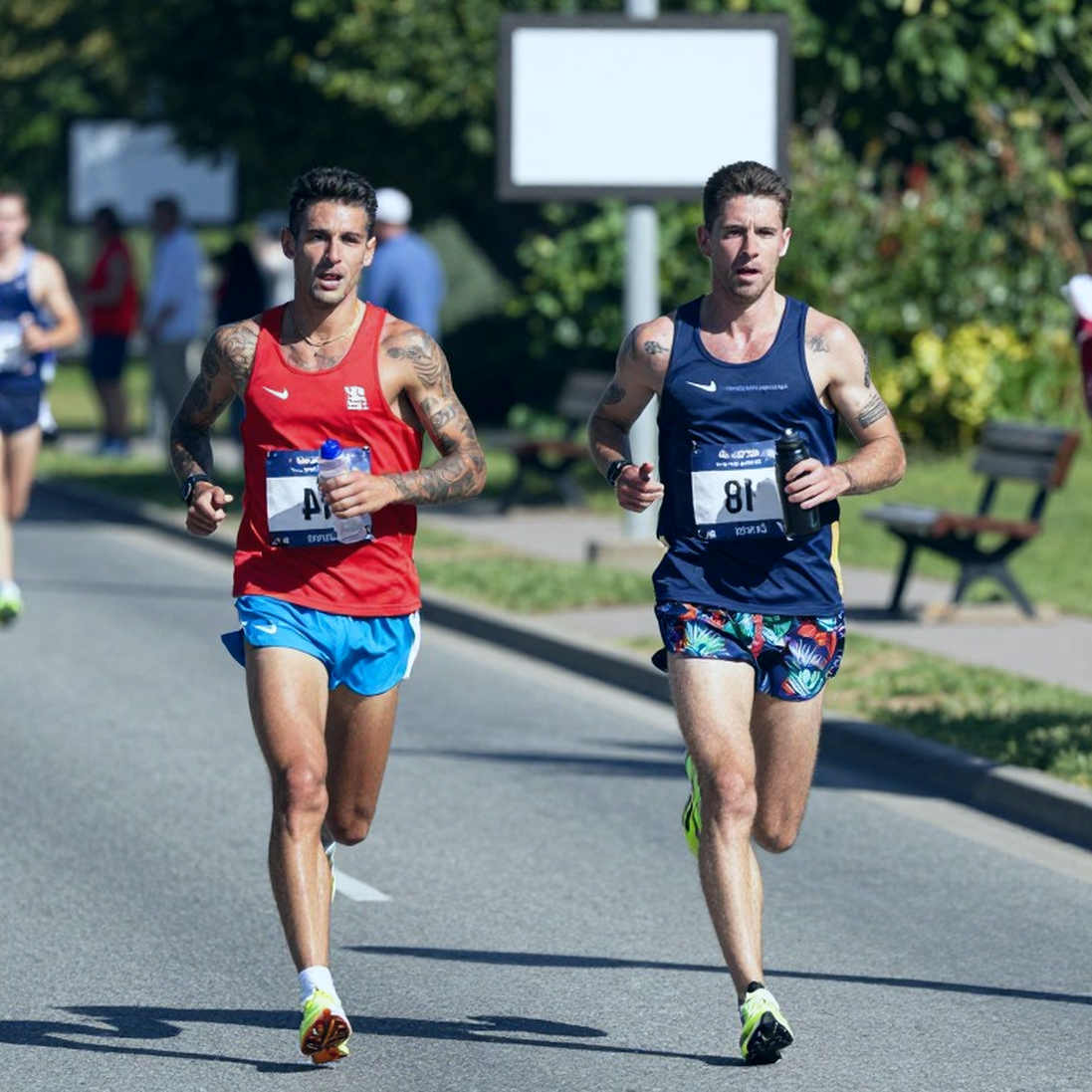
That does not make the result less meaningful. It makes it more interesting. Because it raises a question about the nature of sporting competition: can we imagine a scoring system for disciplines where winning is defined by not quitting?
What the Source Does Not Say, and Why That Matters
I want to list the information gaps systematically, because disclosing what is unknown is part of professional honesty.
No names of the three athletes. No ages. No personal bests. No lap count. No total time. No crew information. No equipment details. No weather data during the race. No information on when the race ended. No specific date — the report says only "Saturday."
Each of those gaps is a hole in my ability to assess. But one gap matters more than all the rest: there is no lap count for the last person eliminated before the three women remained.
Think about that for a moment. If three women were the last standing, there was a moment when a fourth woman, or some man, stopped. If the race lasted thirty laps, that is a respectable achievement. If it lasted sixty laps, that is astonishing. We cannot know. And because we cannot know, we cannot rank this performance against any other benchmark in the discipline's history.
This is a systemic problem for the whole sports media industry. We are getting better at creating compelling stories, and more careless about supplying context for them.

In my trade, we call this the "headline ahead of the data" syndrome. It occurs at every level, from local grassroots races to international championships.
Verification That Does Not Exist
There is a point about sports governance the general reader rarely considers, and it matters here.
The international sports system is built on hierarchy. At the top sit international federations. Below them, national federations. Below those, licensed competitions with technical inspection processes, standardised timing systems, and anti-doping programmes.
The Backyard Ultra sits entirely outside that system. It is not a World Athletics discipline. It is not ranked, has no qualification points, no national championship pathway. It is run by private organisers — in this case a group called Rasselbock — under community conventions.
In such a system, there is no mechanism to confirm a record. No panel to consult historical archives. No repository.
This has a practical consequence: anyone organising a backyard ultra can claim some "first," and as long as nobody else steps forward with contrary evidence, that claim persists as accepted fact within the community.
This is not unique to backyard ultra. It happens in every discipline outside official governance — from coastal running races to small-scale esports.
Tactics never die; they are merely misunderstood until someone is brave enough to try again.
I use that line here with a slightly different meaning. In this case, "tactics" is how we establish truth. And how we establish truth in grassroots sport still has a great deal left to be redone.
What Is Actually Happening in Women's Ultrarunning
Even though the specific "first in the UK" claim cannot be verified, there is a broader trend I believe is real and observable.
Female participation in ultra-distance races has risen continuously for over a decade in most Western countries. In some races, that share has passed 30 percent. In 24-hour races, it tends to be higher than in traditional marathons, because many women choose ultra distances as a space where patience and effort-distribution discipline are valued equally with strength.
At Rasselbock, that share was 21 percent. That is below the average for UK ultras, but it reflects the specific demands of a format requiring severe time commitment.
Within a group of 30, having the top three all be women is a low-probability but not impossible result. It becomes more interesting when we consider how that group of 30 self-selected.
One further possibility, though speculative: if female participation in ultras is rising, then the share of women among veteran ultra runners — those most capable of lasting in a format like backyard ultra — rises with it. Change at the tail of a distribution always precedes change in the middle.
In other words, a woman winning a local ultra in 2026 was a rare exception. A woman winning in 2026 is a predictable outcome, if you have enough data to see the long-term trend.
And this brings me to the final point.
What We Cannot Conclude
I will state plainly what I refuse to conclude from this report.
I refuse to conclude that female athletes have achieved parity of capability at all distances. One race result says nothing about that.
I refuse to conclude this is a turning point in the history of British women's ultrarunning. That is a systemic claim drawn from a single observation.
I refuse to conclude that a pace of 8:57 per kilometre means this race was easy. An easy pace for four hours becomes an unbearable pace over twenty.
I refuse to conclude the organisers' claim is false. I simply have no basis to confirm it.
What I do accept is this: in a format where time is the metronome rather than the judge, three female athletes did what 138 others could not — they were still at the start line when those around them had stopped.
That is a verifiable fact. It needs no headline to matter.
Why This Story Can Be a Mirror
There is a reason I spent so much time on such a short report.
In more than twenty years writing about sport, I have paid increasing attention to disciplines outside the centre. Not because they matter more than the big sports. Because they show me the structure of sport more clearly, like a scale model you can see in full.
Professional football is too large and too complex a machine to see its basic principles clearly. The Backyard Ultra is simple to the point of cruelty: one loop, one rule, one finisher.
In that simplicity, we see what professional sport obscures: that most of the game is not about beating opponents, but about not eliminating yourself.
And in that simplicity, we also see something about women's sport. While speed disciplines remain shaped by physiological differences we cannot yet remove, extreme endurance disciplines are where those differences — for metabolic and tactical reasons — become fainter.
That does not make the Derbyshire result scientific evidence. But it does make it a meaningful signal about a space in which female athletes are gaining more ground.
What I Bring Back From Derbyshire
As I write these lines in Shanghai, it is late, and I am listening again to a recording I have kept on my device since 2026 — the sound of the Moscow stands during the final.
I keep that recording for a simple reason: it reminds me that sport, in its final form, is not a dataset. It is the noise of human beings.
But I also know that without datasets, that noise would mean nothing. If I did not know France scored nine of fourteen goals from set pieces, I would hear only shouting. With the data, I hear a philosophy.
That is why the Derbyshire report frustrates me. Not because it is poor. Because it gives me the shouting and withholds the philosophy.
Those three women did something anyone who has run long distances understands as hard. They were still there after the others had gone home. They stepped out to the start line in a condition the human body was not designed to endure. They did it together, on a Saturday evening in Derbyshire, on the grass of a house built four hundred years ago by a powerful woman.
If there is one thing I want to bring back from this story, it is this: the progress of women in sport is not measured by claims of "firsts." It is measured by the years in which results like this are no longer news.
Fans do not come looking for a team; they come looking for the best version of themselves in the stands.
And in Derbyshire, there were no stands. There was a loop, a horn every hour, and three women still standing while everyone else had stopped.
That is a moment I do not need names to understand. But if I had their names, I would write about them far more fully.
Perhaps next time, when another group of women does something similar, someone will stand at the start line and record the name of the third finisher. Because the name of the third finisher is the measure of whether this discipline has grown up.
For now, we have a handsome headline, an unverified claim, three unnamed women, and a Tudor heritage estate that found a way to draw people onto its grass.
In athletics, we keep every result on file. That is why we can compare a 100-metre runner from 2026 with one from 2026. When a new discipline emerges without archives, it must rebuild its credibility from scratch — by recording names, laps, total times, weather, surfaces.
That is the lesson I bring back from Derbyshire, and it is a lesson for my own profession.
The three women who stood last at Hardwick Estate deserve more than a headline. They deserve a full results sheet.